Saturday, December 13, 2008

Indian Navy Captures 23 Pirates

Indian Navy Captures 23 Pirates
(NSI News Source Info) NEW DELHI - December 14, 2008: The Indian navy captured 23 pirates who threatened a merchant vessel Saturday in the lawless waters of the Gulf of Aden, where dozens of ships have come under attack by gunmen in recent months. An Indian navy ship, the INS Mysore, was escorting merchant ships in the region near Somalia when it received a distress call from seamen on board the MV Gibe, who said they were being attacked by two boats. The Indian Navy apprehends pirates in the Gulf of Aden Saturday after the pirates allegedly threatened a civilian ship The distress call said the pirates were firing as their boats closed in on the Gibe, according to a statement from the Indian government. The pirate boats attempted to escape when they saw the Mysore and its helicopter, but were boarded by Indian marine commandos, the statement said.
The pirates had "a substantial cache of arms and equipment," including seven AK-47 assault rifles, three machine guns, a rocket-propelled grenade launcher and other weapons, the statement said. They also found a GPS receiver and other equipment. The pirates were from Somalia and Yemen, two countries on the coast of the Gulf of Aden. The Gibe was flying an Ethiopian flag, the statement said, but there was no further information about the ship. Last month, India's navy drew criticism after sinking a Thai fishing trawler that had been commandeered hours earlier by pirates. At least one Thai crew member was killed in the attack, which the Indian navy had originally announced by saying it had sunk a pirate "mother ship." The Indian navy defended its actions, saying it had fired in self-defense. Somali pirates have become increasingly brazen, and recently seized a Saudi supertanker loaded with $100 million of crude oil. Many of the vessels are taken to pirate-controlled regions in Somalia, where they are held for ransom. It was not immediately clear what would happen to the pirates captured by the Indians, or where they would be taken. The statement said only that the prisoners and their weapons would be "handed over to appropriate authorities ashore." 'All necessary measures'Most foreign navies patrolling the Somali coast have been reluctant to detain suspects because of uncertainties over where they would face trial, since Somalia has no effective central government or legal system. An estimated 1,500 pirates are based in Somalia's semiautonomous Puntland region, raking in millions of dollars.

UK MoD Confirms Future Lynx Programme

UK MoD Confirms Future Lynx Programme (NSI News Source Info) December 14, 2008: It has been confirmed in a statement today, made by Defence Secretary John Hutton, that the Future Lynx contract signed in June 2006 by the UK Ministry of Defence with AgustaWestland, a Finmeccanica company, will proceed to full scale production. 62 aircraft will be initially procured, 34 for the British Army and 28 for the Royal Navy.
With a common design, sensor and weapon capability, Future Lynx will be optimised for either the maritime or battlefield environments, with the versatility and flexibility to be able to be rapidly switched from one role to another. The aircraft will have a multi-role capability able to perform a range of tasks including battlefield reconnaissance, maritime surface attack and utility lift tasks.
The UK Ministry of Defence also intends to sign a contract within the next few weeks with AgustaWestland that will pull forward Future Lynx programme technologies to provide a rapid upgrade of 12 British Army Lynx AH Mk.9 aircraft with CTS800-4N engines to significantly improve the performance of these aircraft in hot and high operating conditions.
The first four of the 12 aircraft will be delivered in late 2009 and the remaining eight will be delivered in 2010. The CTS800-4N engines and associated equipment will be pulled forward from the Future Lynx programme.
The new engines produce 37% more power than the current Gem engines that are fitted to the Lynx AH Mk.9 giving the aircraft a significant increase in power which will allow the aircraft to operate in extreme hot and high conditions. Graham Cole, Managing Director, AgustaWestland said after the announcement, “We have worked extremely closely with the MoD, as it’s Rotary Wing Strategic Partner, to ensure that the armed services get the new equipment they require as quickly as possible and in the most cost effective way.
I am very pleased to say that Future Lynx remains a critical element of the UK armed forces’ helicopter plans and that the upgrade of the Lynx Mk.9 aircraft will provide a major boost to the British Army’s capability in the short term. We also look forward to working with the MoD to provide the training and support solutions for the Future Lynx.” The Future Lynx programme continues to be on time and on budget and was the first major project to have been awarded under the Strategic Partnering Arrangement signed by the UK Ministry of Defence and AgustaWestland in June 2006.
AgustaWestland has also signed partnering agreements with a number of key supplier on the Future Lynx programme including Selex Galileo, a Finmeccanica company; GKN Aerospace, LHTEC – a partnership between Rolls-Royce and Honeywell, General Dynamics UK, Thales UK and GE Aviation.
The first flight of the aircraft is on schedule to take place in late-2009 with the first airframe having entered final assembly last month ahead of schedule. The Future Lynx deliveries will commence in 2011 and enter operational service with the British Army in 2014 and the Royal Navy in 2015.

China, India Conclude Joint Anti-Terror Military Training With Comprehensive Drill

China, India Conclude Joint Anti-Terror Military Training With Comprehensive Drill
(NSI News Source Info) BELGAUM, India - December 13, 2008: Chinese and Indian troops completed their anti-terror military drill Friday at 10 a.m. of local time, one hour earlier as scheduled. Lieutenant General Ma Xiaotian, head of the Chinese military observer delegation and deputy chief of the General Staff of the People's Liberation Army of China, declared conclusion of the joint training at the closing ceremony, saying the drill was "successful and effective". The seven-day joint anti-terror military training included display of weapons and equipment, communication of tactics, joint training and the comprehensive drill. It's the third and also the last stage of the joint anti-terror military training between the two sides from Dec. 6 to 12. In Friday morning's drill, Chinese and Indian soldiers began to cordon and search for the "terrorists" in villages after marching to the target area overnight. The scenario of the drill was set as that a group of "international terrorists" secretly entered into two villages in the forest of northwestern Belgaum. The anti-terror soldiers had to "catch or kill" them without hurting innocent villagers. The troops first searched one village, "shooting to death" one "terrorist" and arresting two. After interrogation of the two "terrorists", the company got the information that six to eight "terrorists" along with their "zonal commander" were hiding in two double-storied buildings in another village. The commanding officer immediately sent two MI-8 helicopters with a quick action team to the village. Soldiers slithered down the helicopters rapidly. After searching and fighting, they "killed" six "hard-core terrorists including the zonal commander" and recovered large quantity of arms and ammunition. Ma said that the joint training marked the continuous progress the Chinese and Indian armies have made in communication and cooperation. "It showed the resolution of the two sides to safeguard regional peace and stability and create a harmonious environment for development together," Ma said. The Indian military attache in China G. Jaishankar said that the joint training "marked a new step in the bilateral military cooperation". Lieutenant General Noble Thamburaj, general officer commander in chief of the Southern Command of the Indian Army, told a press conference held after the ceremony said the joint training has proved the professional competence of both the contigents.
Chinese and Indian soldiers attend the comprehensive drills of the "Hand in Hand 2008" China-India army joint anti-terrorism training in Belgaum of India, Dec. 10, 2008. The training sessions of the joint anti-terrorism training went on smoothly. During the sessions, the soldiers will train in anti-terror shooting and raids, exchange views on anti-terror theories and civilian and judicial issues, and carry out comprehensive drills with the theme of closing, controlling and searching
He said the experience gained during this joint training would help both the armies to develop a common perspective on tackling the menace of international terrorism. "It has instilled confidence in each other's capabilities to tackle the common threat of terror," he said. "The biggest impact of this joint training will be on future relations on our two countries," he said. The two armies held their first joint anti-terrorism military training in Kunming, southwest China's Yunnan Province last year. Senior Colonel Tian Yixiang, head of the Chinese military experts group, said compared with the "Hand-in Hand 2007", learning from each other is a significant part of this year's joint training. In order to achieve this goal, the soldiers from two countries were mixed into different groups, listened to lectures together, held discussions, and learned to use weapons of each other, Tian said.
Chinese and Indian soldiers attend the comprehensive drills of the "Hand in Hand 2008" China-India army joint anti-terrorism training in Belgaum of India, Dec. 10, 2008
"We've learned a lot from the experience they gained from practical anti-terror battles and they appreciated the strong mind and good tactics of our side," he said.

Pakistan: Tribal Laws Unabated In NWFP (Border Area With Afghanistan)

Pakistan: Tribal Laws Unabated In NWFP (Border Area With Afghanistan)
(NSI News Source Info) December 13, 2008: Vehicles destroyed by militants in Peshawar, Pakistan, Friday, Dec. 12, 2008. Pakistan deployed paramilitary troops to a group of terminals used by vehicles supplying NATO and U.S. troops in Afghanistan after the latest in a string of attacks burned more than two dozen trucks, police said Friday.
A man looks at vehicle bound for the U.S. and allied forces in Afghanistan, as other vehicles destroyed by militants are seen in the background, in Peshawar, Pakistan, Friday, Dec. 12, 2008

China Maintained Strategy Defense In Spite Of Global Recession

China Maintained Strategy Defense In Spite Of Global Recession
(NSI News Source Info) December 13, 2008: The global recession is having an impact on China, but not one that is expected to halt the growth in military spending. Currently, China expects the growth of its economy will slip, from the 11.9 percent last year, to five percent or less this year. That would be the lowest annual growth for several decades, and it might get worse. Nevertheless, the government is spending hundreds of billions of dollars to soften the blow of lost jobs. A million or more unemployed workers could cause social disorder that might get out of hand. Japan, China and South Korea are forming a joint disaster preparedness organization. The three would pool information and disaster relief resources, for natural disasters like widespread earthquakes or typhoons that have an impact on all three countries. This cooperation would involve purely civilian agencies, as well as some military ones. Recent talks between the president of France and the Dali Lama (the unofficial leader of those who campaign for Tibetan independence) angered China, and diplomatic protests were made. France ignored this, but now the French embassy in China is under hacker attack and largely shut down. The Chinese government denies any responsibility. Former Taiwanese president Chen is being prosecuted for corruption. Chen resigned last August because of the charges. His family has been investigated for corruption over the last two years. Corruption is more common in China, but more often prosecuted in Taiwan. China is demanding that the United States cancel arms sales to Taiwan, and refuses to resume U.S.-China military cooperation and exchanges until those arms sales are cancelled. India has sent over a hundred troops to China for joint counter-terror training. These exercises are to work out differences in communications and tactics, so that future joint operations will go more smoothly. China has set free a thousand of the those arrested during the separatist riots in Tibet last March. Hundreds more have been prosecuted and sent to prison. Thousands of additional riot police remain in Tibet, and the secret police keep a closer eye on anyone suspected of separatist attitudes. Recruiting of informers in separatist circles has increased, and Chinese officials in Tibet are under orders to prevent another uprising, or else (they lose their jobs, or even their freedom.)

Deadly Weapons Export Tripled

Deadly Weapons Export Tripled
(NSI News Source Info) December 13, 2008: Since September 11, 2001, annual U.S. weapons exports have tripled to over $32 billion. The customers (174) include nearly all the worlds nations. Most of the sales (by dollar terms) go to Arab nations in the Persian Gulf. There, the growing fear that Iran will resume its historical role of regional superpower, and attempt to take over the oil rich nations on the west coast of the Gulf, has triggered massive armaments purchases. So far, Iran has occupied some disputed island in the Persian Gulf, and claims it should control southern Iraq and eastern Arabia, because of the Islamic shrines located in those places.This has caused the Arabs to ready for war. Throughout this period, most of the chaos in the world was still armed by Cold War surplus, sold cheap by former communist nations after 1991. In addition, China and Russia continue to be the suppliers of last resort for outlaws. North Korea and Iran will also sell to anyone. It's recently been revealed that China has been the primary exporter of nuclear weapons technology (to North Korea and Pakistan, both of whom passed it on, for a price). U.S. weapons are sought because they are combat proven, and U.S. suppliers have a track record for good service. U.S. operations in Iraq and Afghanistan have been witnessed firsthand by Arab military men (unofficially) and they have reported on the effectiveness of U.S. equipment. Several Arab countries have quietly sent special operations units to Afghanistan, and individual military observers and operatives to Iraq.

Somalia Ungovernable Country

Somalia Ungovernable Country
(NSI News Source Info) December 13, 2008: Violence continues in Mogadishu, as pro and anti-Islamic radical clans fight for control of the city.
At least one large group of pro-Islamic radical (Shebab) gunmen is wandering around central Somalia, raiding towns controlled by anti-Islamic radical clans. Uganda and Burundi want to withdraw their peacekeeping troops from Mogadishu as soon as possible. The UN has been unable to obtain additional peacekeepers to replace the 2,000 Ethiopians that will withdraw by next month, and the 3,400 Ugandan and Burundi troops do not want to be left in the chaotic city all by themselves.
Meanwhile, the Transitional National Government (TNG) has largely fallen apart. After several years of effort, and international support (especially from southern neighbor Kenya) the TNG has lost most (at least 80 percent) of the 15,000 soldiers and police that foreign aid paid to equip and train. The men have gone back to their clans and warlords, taking their uniforms and weapons with them. Kenya has agreed to accept, and prosecute, pirates arrested off the coast of Somalia. The pirates will be tried under Kenyan law, but foreign countries will provide money to help pay for the proceedings. December 11, 2008: The U.S. is proposing that the UN authorize members to "take all necessary measures ashore in Somalia" to deal with the pirates. Many African, and Arab, UN members oppose such a blanket permission, fearing it would lead to many Somali civilian casualties. December 10, 2008: Somali pirates seized two Yemeni fishing ships, and 17 crew members. But seven fishermen escaped in a small boat to report the seizures off the Yemeni coast, near the port of Aden. December 6, 2008: Islamic radical (Shebab) raided the town of 370 kilometers north of Mogadishu. There were several dozen casualties. Meanwhile, Somali pirates continue to operate far into the Indian ocean, as two speed boats tried, and failed to take a large container ship 800 kilometers off the coast of Tanzania (which is south of Somalia's southern neighbor Kenya). This is apparently the same gang that seized a Saudi oil tanker last month. The two speed boats were towed by a larger mother ship, which is patrolling the sea lanes for ships too large for the Suez canal, and that must go around South Africa. The crew of the container ship could see the mother ship, a large fishing boat, in the distance. December 5, 2008: A Danish warship rescued seven men found drifting in the Gulf of Aden in a speedboat with a broken outboard engine. The seven were armed with AK-47s and RPGs. These were confiscated and the speedboat was sunk. The men were obviously pirates, but because they were not attacking anyone when the Danes found them, the Danes could not arrest them. The seven pirates were handed over to the Yemeni coast guard, which probably means these Somalis are out of the piracy business for good.

Australian Navy New Comfy Uniform

Australian Navy New Comfy Uniform
(NSI News Source Info) December 13, 2008: The Australian Navy is issuing a new work uniform (AUSCAM, for Australian camouflage) to sailors. It looks like the camouflage type pattern combat uniforms soldiers wear, except that the camo pattern is mostly grey, black and green splotches. From a camouflage point of view, it won't hide anyone. But that's not the point.
The navy developed the new uniform so that sailors would have a distinctive, and more comfortable, work uniform. It makes a statement, along the lines of, "we're sailors from Oz, and we're cool."
Testing has shown that the uniform is more comfortable, and cooler to wear in tropical climates (where Australian sailors frequently operate.) The uniform it replaces was basically a set of grey overalls. Not very distinctive at all. The white uniform, often worn by sailors working in offices, will still be used.

Friday, December 12, 2008

Ukrainians Complete Mission In Iraq

Ukrainian Contingent Ends Iraq Mission, Head Home
(NSI News Source Info) CAMP ECHO, Iraq - December 13, 2008: The Ukrainian Army hosted an end of mission ceremony at Camp Echo in Central Iraq Dec. 9. More than 5,000 Ukrainian troops have served in Iraq during Ukraine's five years of service in support of Operation Iraqi Freedom.
"Enduring peace, stability and prosperity are common values to fight for in the modern world. Your mission in Iraq has been successfully completed," said Viktor Nedopas, Charge d'Affairs of the Ukrainian Embassy in Iraq.
The Ukrainians served as the third-largest Coalition forces contingent in Iraq, with about 1,700 soldiers from 2003-2005.
"Ukraine started accomplishing its mission in Operation Iraqi Freedom through assistance to the Iraqi government to establish constitutional order and a secure environment from the very beginning in 2003," said Col. Henadii Lachkov, senior commander for the Ukrainian forces in Diwaniya.
In 2006, they shifted their operational focus and down-sized to a peacekeeping force of about 40 soldiers. They also moved their operations from al Kut to Diwaniya, about 180 kilometers south of Baghdad, under Polish command for specialized Iraqi Army and Iraqi Police training.
"We know that violence is at its lowest level in five years, and the Iraqi Security Forces, partnering with Coalition forces, will take the lead in defending their country," said Maj. Gen. Michael Ferriter, deputy commanding general for operations, Multi-National Corps-Iraq.
"And soon, the Iraqi people will vote in the future of their country in the provincial elections. These changes were not brought about naturally, but were instead brought about by the dedication and the hard work of the men and women from the nations such as yours. You helped create the Iraqi Security Force and instilled in them a solid foundation of skills essential to the future security and prosperity of Iraq," said Ferriter.
"To Iraq's benefit and through Ukraine's efforts, you have helped ensure a higher quality of life for the people of Iraq. Ukraine forces made contributions that enabled all Coalition partners to be successful here, but it has not been without cost. A precious 18 Ukrainian Soldiers have died here," said Ferriter.
Lachkov led a moment of silence during the ceremony to honor those who gave their lives and the family members they left behind.
"You have allowed peace to grow in the region, and now, you can return home knowing that you made that difference. Thank you for being a part of this Coalition," said Ferriter.
Words, gestures and gifts shared during the ceremony solidified friendships among the different nationalities that have fought and worked together for a better Iraq.
"We are leaving this place, but Ukrainian color will (still) be represented in the Republic of Iraq. Our Soldiers will continue serving in the NATO training mission, making their contribution into the matter of developing democracy, stabilizing the internal situation in Iraq and providing support to the Iraqi Security Forces," promised Lachkov.
Countries that remain with the Coalition in Iraq include: Albania, Australia, Bulgaria, Denmark, El Salvador, Estonia, Lithuania, Romania, the United Kingdom and the United States.

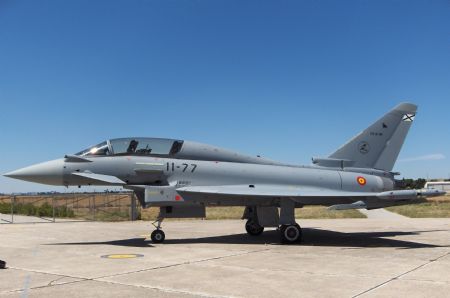
Spain Receives First Tranche 2 Eurofighters

Spain Receives First Tranche 2 Eurofighters
(NSI News Source Info) December 13, 2008: The Spanish Air Force (SpAF) has received the first three Eurofighter production aircraft of Tranche 2. The fourth unit will be delivered in the near future. The delivery follows the Type Acceptance agreement for Block 8 (Tranche 2) achieved on 12th September.
Enrique Barrientos, CEO of EADS Defence & Security in Spain, underlined that “the Spanish Air Force is more and more getting benefit from the maturity achieved by the most advanced new-generation combat aircraft in operation. The delivery of these Tranche 2 aircraft steps into the following phase of operational capabilities for our customers and underlines the continuous technological enhancement of the weapon system”.
According to the production umbrella contract, the four Partner Nations committed themselves to the acquisition of 620 Eurofighter aircraft in three tranches, and Spain participates with 87 units. The delivery of the Tranche 1 (19 aircraft for SpAF) concluded in September last year. Tranche 2 foresees the production of 34 new SpAF aircraft. The main difference between Tranche 1 and Tranche 2 aircraft is a new suite of computers and enhanced air-to-ground capabilities. More processing power (speed and memory capacity) will be the enabler for capability insertion.
Moreover, all Tranche 2 aircraft already delivered will eventually go through the Phase One Enhancements programme, agreed in March 2007, integrating the latest achievements. This programme covers new software and an enhanced multi-role Human-Machine Interface (HMI). Furthermore, the Multiple Information and Distribution System (MIDS), the Global Positioning System, the Defensive Aids Subsystems and the communication systems will be upgraded. Finally this programme foresees the integration of the Laser Designator Pod (LDP) and of additional weapons such as Paveway IV and EGBU-16.
Meanwhile the four Eurofighter partner companies continue with the development programme of advanced solutions for the Eurofighter weapon system. Deliveries of Tranche 2 aircraft to the customer air forces have started on 10th October 2008 with the handover of BS040 to the Royal Air Force. More than 60 Block 8 (Tranche 2) aircraft are currently in the final assembly lines across the four partner companies.